Winter is coming. How much heat do you need?
Less light means your plants need less warmth than you might think. In about three minutes we'll show you what that means for your greenhouse this week, using only your location.
Tell us about your greenhouse
We only use this to fetch the local weather. Nothing is stored.
What is RTR?
RTR stands for Ratio Temperature to Radiation. Simply put: how warm your greenhouse should be for the amount of light your plants got today.
Light is the fuel plants use to make sugars. Temperature decides how fast they spend them. Warm on a dark day? Plants burn sugars they never made. Cool on a bright day? You waste the sun's free energy. RTR draws a straight line between the two. Try it:
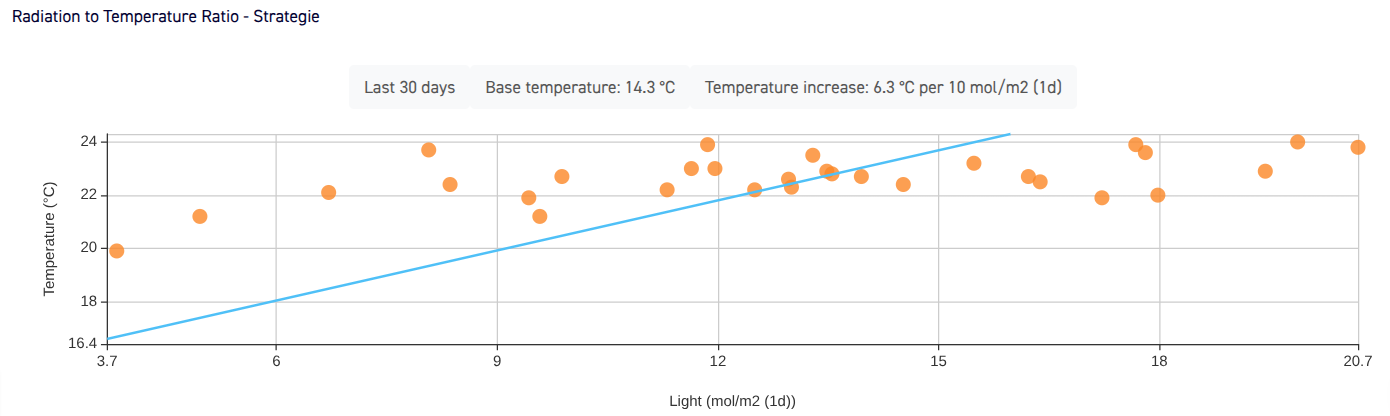
This line is a real grower's strategy: start at 14.3 °C, add 6.3 °C for every 10 mol/m² of light, and never go above 24 °C.
What RTR looks like with sensors
Each dot is one day from the last 30 days: how much light the crop really got, and the average temperature the greenhouse really had. The blue line is the grower's strategy, the same one as in the slider above.
Your light this week
Do you have a PAR sensor in your greenhouse?
A PAR sensor measures the light your plants can use. Your climate computer or sensor dashboard usually shows it as a daily light sum in mol/m².
Why light matters
- Light is the plant's income: every bit of it becomes sugar and growth.
- Growers count light per day, like a daily total in a bank account.
- As a rule of thumb, 1% more light gives about 1% more yield.
Limits of weather data
- It measures the sky above your area, not under your roof.
- A passing cloud over your greenhouse but not the weather station isn't seen.
- We don't know your glass, screens, whitewash or grow lights.
How to get more exact
Check the light meter on your climate computer, or measure light at plant height with a light sensor. Then you see exactly what your crop receives, hour by hour and spot by spot.
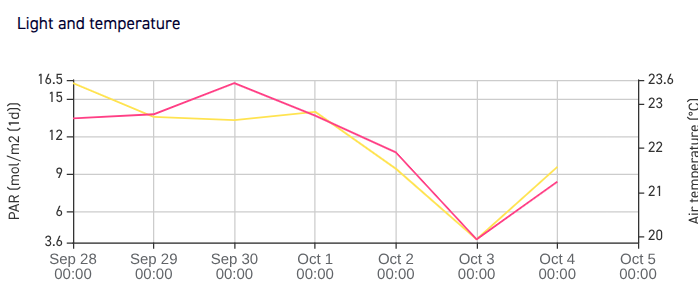
Your temperature this week
Do you measure temperature in your greenhouse?
For example with your climate computer or a sensor at crop level.
Why temperature matters
- Temperature sets the speed of the plant: growth, flowering and ripening.
- Plants mostly react to the 24-hour average, so a cool night can make up for a warm day.
- It's the main knob you control, and often the biggest cost on your energy bill.
Limits of weather data
- Outside temperature is not greenhouse temperature: heating, screens and the sun all change it.
- Inside, it differs between the top and bottom of the crop and between corners.
- The plant itself can be warmer or colder than the air around it.
How to get more exact
Measure temperature at crop level in several spots. That shows hot and cold zones your climate computer's single sensor box might miss.
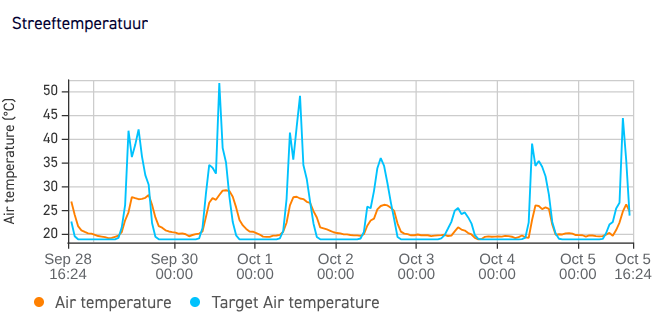
Your suggested temperature
Your RTR strategy
Pre-filled with the real grower's strategy from the intro. Know your own? Change it.
Read this as a starting point
This combines an estimate of your light from the weather with an example strategy. Every crop, variety and grower is different, so the right line for you may be higher or lower. Compare it with what your climate computer does, and see where the two differ.
Growing together since 2015
30MHz is a data and sensor platform for horticulture, based in Rotterdam. We place sensors between the plants and turn what they measure into clear next steps. We built this tool to share what we've learned with growers.
"Data-driven growing gives us better plant quality, better planning and lower energy use."
Anthura
"After a year we can compare with last season and adjust our plans."
Dümmen Orange
"Accurate substrate data lets us act straight away instead of losing yield."
Piñata Farms
Curious about your own numbers?
Read more at 30mhz.com, or ask us anything at support@30mhz.com.